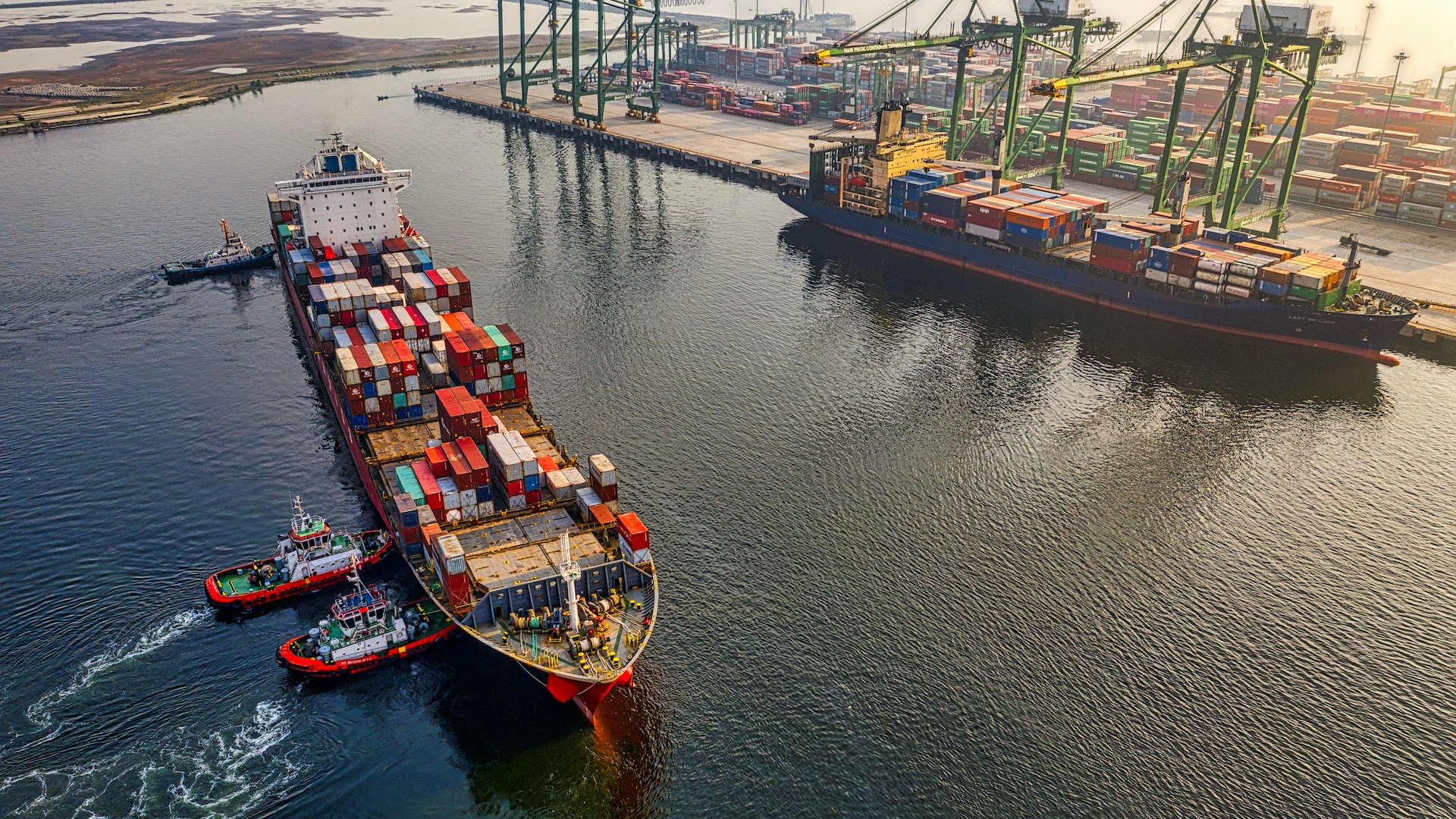
If you've ever looked out at the water near a major port, you've probably seen a queue of container ships sitting on the horizon, engines running, going nowhere. It looks like a traffic jam on the water… because it is.
In this hurry-up-and-wait scenario that’s all too common, vessels spend 5–10% of their total operating time at anchor or drifting slowly because they’ve rushed to port only to find the berths, cargo handlers, or related services aren't ready for them. And with shipping moving over 80% of global trade and accounting for ~2% of global carbon emissions — more than Germany's total CO₂ output — every bit of wasted engine time matters.
Just in Time (JIT) arrival is a shipping strategy that’s making waves as a way to tackle this problem, reducing fuel use and congestion, cutting costs, and slashing emissions. In fact, Climate TRACE recently identified JIT as a top strategy for reducing shipping emissions, recognizing that cutting port loitering could yield ~10% average emissions savings in international shipping, and ~12% per port in domestic shipping.
Just in Time arrival allows vessels to optimize their speed during a voyage so they arrive at port only when the berth, fairway, and nautical services are actually ready.
It’s a complicated dance, given port operations are inherently dynamic, constantly shifting based on cargo readiness, weather, and logistics on land. Many actors are involved — logistics companies, facilities, capabilities even within a port. The port authority manages vessel movement, but all the warehouses are other players.
All this means vessels aren't just waiting for berths; sometimes they're waiting for market signals that indicate the best time to offload in terms of price and conditions.
Instead of sailing to a static estimated arrival time and hoping for the best, JIT aims to provide continuous, real-time information exchange between ports, terminals, and vessels — so ships can plan accordingly. It’s like with aviation: planes routinely adjust speed to match landing slots, saving fuel and avoiding stacking patterns over airports. Ships can do the same.
JIT works using a synchronized digital ecosystem that connects shipboard navigation systems with shoreside port management platforms via real-time data sharing. Software automates the exchange of berthing schedules and speed-optimisation data to ensure vessels arrive exactly when resources are ready, minimising idle time and fuel waste.
By moderating speed progressively and intelligently, JIT avoids unnecessary anchoring, circling, and low-speed maneuvering near ports, reducing both fuel use and congestion.
The opportunity is substantial in terms of emissions reductions. An estimated 15% of global marine fuel consumption occurs during port stays, anchorage, or low-speed operations. Much of that fuel is wasted — burned while waiting, not moving. JIT targets exactly this inefficiency.
Examples of JIT in action are cropping up around the globe.
A 2020 trial at Rotterdam showed average fuel savings of 8–9% for participating vessels, leading to a 2024 system that assigns designated berth times when vessels enter a geo-fenced area. In one simulated voyage between Bremerhaven and Rotterdam, JIT delivered 23% lower fuel consumption compared to business-as-usual, driven by earlier and repeated arrival time updates.
Singapore has taken a similar approach, providing vessels with 72 hours’ notice of specific berthing times across multiple terminals, enabling speed adjustments well before arrival.
The Ports of Los Angeles and Long Beach introduced a queuing system in 2021 that assigns predetermined positions to vessels when they depart their previous port, reducing the race-to-port-and-idle pattern. And the Panama Canal recently opened its NetZero Slot, with JIT service baked in at no additional cost. Results aren’t in yet, but the move does point to growing adoption.
The potential is clear, but implementation is complex. Challenges include:
There is no silver bullet for all these challenges, but broadly speaking, data are key. Advanced data and visibility tools can help ports understand the scale of their own problem, identifying where vessels are waiting longer and revealing opportunities to reduce idling times through different prioritisation of berth usage.
JIT won't solve shipping's emissions crisis alone, but it's one of the few strategies that can be deployed now, with existing fleets, using primarily software and coordination rather than waiting for alternative fuels or new engines.
Even partial JIT implementation (e.g., optimising just the last 12–24 hours of a voyage) can deliver meaningful emissions reductions, making it a practical stepping stone rather than an all-or-nothing shift.
Structured data sharing and coordination are critical; new AI capabilities are creating additional possibilities. JIT depends on alignment among shipowners, charterers, ports, terminals, pilots, tug operators, and inland transport, all making governance and trust as important as secure technology. Shipping leaders need to consider how JIT could support their organisational goals, learn more about the challenges and opportunities, and support efforts to grow the body of research and adoption.
Early research shows JIT, implemented with care, can and does lead to meaningful emissions reductions. The challenge now is to turn promising pilots into standard practice, making sure the data and infrastructure exist to support it at every scale, from Singapore to smaller national ports.
hero image: pexels / tomfisk